.svg)
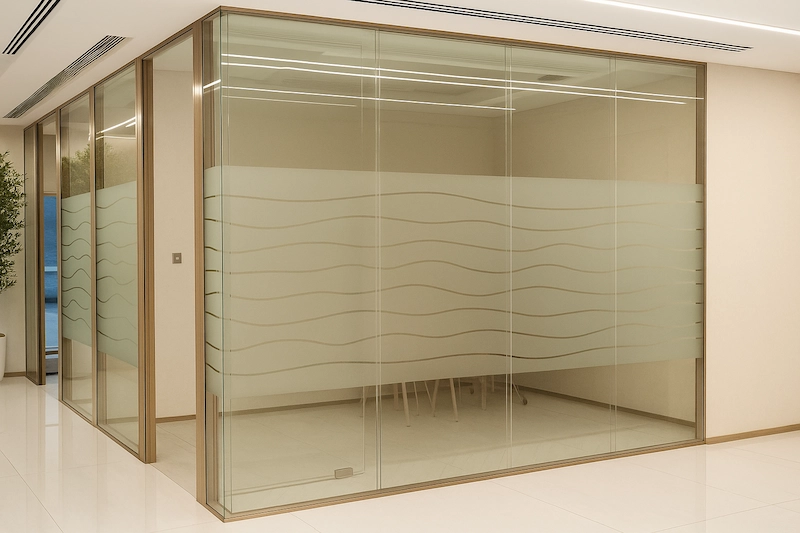
Office Glass Frosting & Etching Services in Abu Dhabi: The Technical Comparison
Deciding between permanent etched glass and applied frosted stickers for your commercial fit-out? Here is the technical, cost, and lease-compliance breakdown for Abu Dhabi tenants, fit-out consultants, and facilities leads—backed by manufacturer durability data.
Abu Dhabi commercial fit-outs lean heavily on glass — Grade A partitions, glazed meeting rooms, public-facing storefronts. Privacy and brand presence on that glass comes down to two real options: permanently altered glass (sandblasted or acid-etched) or applied frosted film.
They look similar on day one. They behave very differently across cost, lease compliance, branding flexibility, and durability in Abu Dhabi conditions. This guide compares them against manufacturer-published figures and the decision factors that actually matter during a fit-out.
The Two Techniques, Briefly
Etched glass — permanent alteration of the glass itself
Etched glass means the glass surface has been physically or chemically altered. Two methods dominate in the UAE:
- Sandblasting abrades the glass with high-pressure grit, pitting the surface into a translucent finish. Highly durable; prone to fingerprint shadowing if not sealed.
- Acid etching uses a chemical bath to produce a smoother, more uniform matte.
Both are irreversible. Once the glass is etched, that pattern is permanent for the life of the panel.
Frosted film — applied decorative vinyl on existing glass
Frosted film is a self-adhesive decorative film bonded to the glass surface. Material chemistry varies by family: 3M FASARA uses polyester and polyvinyl chloride; ORACAL 8810 is cast PVC; 3M Dusted and Frosted CRYSTAL is vinyl; Avery Dennison SC900 is specialty cast vinyl.
Film is non-destructive — it can be removed and re-specified without replacing glazing.

Side-by-Side Comparison
Cost
Etched glass is a new-panel cost: fabrication, transport, site delivery, panel removal, and glazing installation. For a typical Abu Dhabi office partition replacement, this runs multiples of what filming the existing glass would cost, because the film alternative works on glass that's already installed.
Frosted film is an applied cost: supply of the roll material plus surface preparation, cutting, and wet application on existing glass. Labour per square metre is comparable; the saving is the panel-replacement cost avoided entirely.
Practical effect: frosted film is commonly treated as fit-out operating expense; etched glass enters the capital expenditure conversation because it's a glass build element.
Durability
Manufacturer-published Expected Performance Life varies by film family and glazing position:
- 3M FASARA — 5 to 20 years on interior vertical non-perimeter glass, per the current 3M FASARA Product Bulletin.
- 3M Dusted and Frosted CRYSTAL — 15 years interior non-perimeter, 5 years interior perimeter, 3 years vertical exterior, per 3M CRYSTAL TDS Revision I.
- ORACAL 8810 Frosted Glass Cast — indefinite indoor life; 7 years Zone 1 exterior, reducing to 3 years Zone 3. Abu Dhabi is classified as Zone 3 in ORAFOL's country list.
- Avery Dennison SC900 — 15 years interior non-perimeter for Dusted Crystal Matte; 5 years vertical exterior across the specialty film range.
Etched glass has no equivalent "expected performance life" — the surface alteration lasts as long as the glass panel remains in place. For a lease shorter than 20 years, that longevity is surplus. For a head-office building owned outright, it matters.
Branding Flexibility
Etched glass is commissioned once. The pattern is permanent. Any branding refresh — logo update, company rename, space reconfiguration — requires replacing panels.
Frosted film is plotter-cut or printed. This allows:
- Cut-out logos in a frosted field (reverse-cut manifestation)
- Repeating geometric patterns sized to glass proportions
- Gradient transitions from opaque to clear
- Printed colour on frosted substrate, on a user test-and-approve basis per 3M CRYSTAL documentation
These options aren't available in etched glass without specialist CNC fabrication at significant cost. For branding-led fit-outs, film is practically the only choice.
Lease Compliance and Reversibility
Most Abu Dhabi commercial tenants operate on multi-year leases with reinstatement clauses — the space is handed back as it was received. Etched glass triggers these clauses: removing etched panels means glazing replacement, which is a landlord-specification conversation, not a handover checklist item.
Frosted film removes from sound glazing using correct technique. Residue risk is substrate-and-dwell-time dependent but manageable on standard commercial glass. For leased commercial space, this is the deciding factor in most briefs — the film option preserves the landlord's asset and keeps reinstatement a same-day operation.
Glass Manifestation (Safety Marking)
Glass manifestation — visible markings on large areas of clear glazing to prevent walk-through collisions — is a common fit-out requirement. The typical two-band layout at 850–1000mm and 1400–1600mm from finished floor level originates from UK Approved Document M and BS 6262-4, widely adopted by Abu Dhabi fit-out designers and facilities teams as best practice.
Both etched glass and frosted film can satisfy manifestation. Frosted film is usually preferred because:
- Same material serves privacy and manifestation — no second specification
- Logos, dual bands, and motifs can be cut from the same frosted run
- Changes to markings don't require re-fabricating glass

Abu Dhabi Environmental Factors
Heat and UV Exposure
On exterior-facing glass, film selection is a thermal decision. Films with areas of high opacity or dark-coloured ink absorb more heat than the adjacent clear glass — 3M explicitly warns of this in the CRYSTAL Technical Data Sheet, because differential heating creates thermal expansion that can crack glass not specified for the load.
Abu Dhabi sits in ORAFOL's Zone 3 classification for sustained heat and UV — the hottest, highest-UV band in the three-zone system. Rated exterior life for cast PVC films reduces by more than half vs temperate Zone 1. Specification must match the zone, not the manufacturer's headline figure.
Humidity and Coastal Salt Load
Coastal Abu Dhabi sites — Al Raha, Saadiyat, Al Reem — carry higher atmospheric moisture and salt load. This increases edge-lift risk if installation uses low-tack adhesive or skips surface preparation. Permanent-adhesive films (Etchmark, Frosted Sparkle) with wet-application technique on deep-cleaned glass handle these conditions; removable adhesives (Dusted Crystal Matte) need care in coastal exterior positions.
Maintenance
Frosted film is easier to maintain than raw sandblasted glass. Sandblasted finishes trap fingerprint oils on the micro-pitted surface, requiring specialised cleaning. Film cleans with water and mild detergent after the 30-day post-install cure. Ammonia, chlorine, and organic solvents are excluded across all major film manufacturers.
Which Solution Fits Your Brief?
The choice splits cleanly along four factors: tenure, budget, brand volatility, and position on the building.
Leased commercial space:
Frosted film wins decisively. Reinstatement clauses make etched glass a costly exit — the panel has to be replaced, not reverted. Film removes from sound glazing and preserves the landlord's asset.
Owned head office:
Both work. Etched glass reads as permanent architectural intent; frosted film retains the flexibility to rebrand without touching the glass build. The decision is aesthetic, not structural.
Branding likely to change within five years:
Frosted film is the only practical answer. Plotter-cut logos, printed motifs, and pattern updates happen at film cost, not panel cost. Etched glass locks the design to the glass.
Budget-constrained fit-out:
Frosted film, with no caveat. Applied cost per square metre sits well below new-panel etched-glass cost across the typical Abu Dhabi project scale.
Public-facing facade in Abu Dhabi sun:
Film is viable provided specification matches the zone — ORACAL 8810 at Zone 3 durability is the exterior default. Etched glass has no zone-reduction issue but carries the full panel-replacement cost.
Interior partition privacy:
Frosted film leads — 3M FASARA for decorative interior work, 3M CRYSTAL where printed branding enters the spec. Etched glass is acceptable on owned partitions but rarely justified on leased ones.
Safety manifestation only:
Frosted film is the proportionate answer — reverse-cut manifestation on applied film delivers the requirement without commissioning etched panels for what is, at core, a compliance marking.
Prestige head-office where permanence is the statement:
Etched glass has a genuine role here. When the message is "this is our building and this glass was made for us," film is the wrong specification — film works in any other brief, but not this one.
For most Abu Dhabi commercial briefs — leased space, branding-led, fit-out-timeline-constrained — frosted film is the practical answer. Etched glass retains a genuine role in owned, prestige, long-horizon settings where permanence is the architectural intent.

Frequently Asked Questions
Is frosted film cheaper than etched glass?
Yes, materially. Frosted film applies to existing glass and costs per square metre, not per panel. Etched glass carries new-panel fabrication, transport, and installation costs. For a typical Abu Dhabi office partition, film is a fraction of etched-glass cost.
How long does frosted film last compared to etched glass?
Etched glass lasts the life of the glass. Frosted film carries manufacturer-published Expected Performance Life ranging from 5 to 20 years on interior applications depending on film family and design. For lease durations under 20 years, film's rated life is usually surplus to requirement.
Can frosted film be removed at end of lease?
Yes. Frosted film removes from sound glazing using correct technique — heat-assisted peel followed by adhesive-residue treatment. This is the primary reason film dominates specification for leased commercial space. Etched glass cannot be reversed.
Does frosted film block as much visibility as etched glass?
Obscuring effect is comparable at daytime for most film finishes. Visible Light Transmission is typically 65–90% depending on density. At night with interior lighting on and exterior dark, silhouettes close to the glass may be faintly visible through frosted film — this is film physics, not a defect, and applies to etched glass as well. Higher-density finishes or supplementary blinds handle night-privacy requirements.
Is frosted film suitable for Abu Dhabi exterior glass?
Yes, with correct film selection. ORACAL 8810 Frosted Glass Cast is the exterior frosted default, rated 3 years in Zone 3 where Abu Dhabi sits in ORAFOL's country classification. Interior-rated films (3M FASARA) are not the automatic exterior choice despite having exterior-approved designs — the hot-climate zone reduction matters.
Can frosted film meet Abu Dhabi manifestation requirements?
Yes. The typical two-band layout (850–1000mm and 1400–1600mm from floor level) adopted in Abu Dhabi fit-outs is drawn from UK Approved Document M and BS 6262-4. Frosted film satisfies this using plotter-cut logos, continuous bands, or reverse-cut manifestation — the same film specification serves both privacy and manifestation.
CONCLUSION
For most Abu Dhabi commercial briefs — leased office space, fast fit-out timelines, changing brand requirements, budget pressure — frosted film is the correct answer. It delivers the etched-glass aesthetic at a fraction of the cost, reverses cleanly at lease-end, and handles rebrand cycles that would strand an etched-glass panel.
Etched glass retains its place where permanence is the message and the space is owned outright. It's not obsolete — it's a different brief.
For frosted film specification, project gallery, and pricing guidance, see our Frosted Glass Stickers product page or the full Window Graphics hub.
Related Content

The Ultimate Guide to Pickup Branding: Costs, Designs and Materials
Read Full Article →
Custom Office Wall Stickers & Graphics in Abu Dhabi: The Plain English Buyer's Guide
Read Full Article →
Shop Front Glass Stickers Abu Dhabi: The Ultimate Window Branding Guide
Read Full Article →
One-Way Vision Stickers in Abu Dhabi: Technical Specs & Storefront Applications
Read Full Article →