.svg)

Office Door Sign Types for Offices in Abu Dhabi
Office door signs and room name plates help visitors find rooms, departments, suites, meeting areas, clinics, and staff offices clearly inside Abu Dhabi commercial buildings.
Office door signs and room name plates are the small interior signs people notice only when they are missing, mismatched, outdated, taped to a door, or written on paper like the building gave up.
In Abu Dhabi offices, clinics, schools, hotels, business centres, residential towers, and managed commercial buildings, these signs identify rooms, departments, suites, staff offices, meeting rooms, service spaces, and visitor destinations. They sit at the final stage of the visitor journey, after the lobby directory and directional signs have guided someone to the correct floor or corridor.
A complete door and room identification system usually includes office door signs, room name plates, office name plates, department signs, room number plates, suite signs, meeting room signs, changeable inserts, and sometimes privacy sliders for occupied or available rooms.
For larger buildings, these signs should not be treated as one-off plates. They should connect visually with the wider interior signage system and the building’s wayfinding signage, so visitors move from reception to corridor to final room without asking three people where Accounts is. A bold achievement for civilization.
What Office Door Signs and Room Name Plates Mean
In the UAE market, buyers use many names for the same family of products. Some call them office door signs. Others ask for room name plates, office name plates, acrylic door signs, door name plates, office door name plates, room number plates, department signs, office cabin signs, suite signs, wall name plates, office name boards, or office sign boards.
The correct product depends on what the sign must identify.
An office door sign normally identifies a private office, staff room, manager cabin, meeting room, department, or operational area. A room name plate identifies a fixed room name, such as Boardroom, Accounts, HR, Pantry, Server Room, Consultation Room, or Treatment Room. A room number plate identifies a numbered space, such as Room 104, Suite 2203, Apartment 1207, or Clinic Room 6.
A department sign identifies a team or function. A suite sign identifies a tenant, office suite, clinic, or commercial unit. A changeable name plate allows the printed name, doctor name, staff title, tenant name, or designation to be updated without replacing the whole sign.
That last part matters in Abu Dhabi offices where staff, tenants, doctors, teachers, departments, and room uses change. A fixed engraved plate looks clean, but a modular insert system may save money if the information changes often.
Office Door Signs vs Room Name Plates vs Department Signs
The terms overlap, but they are not always the same product.
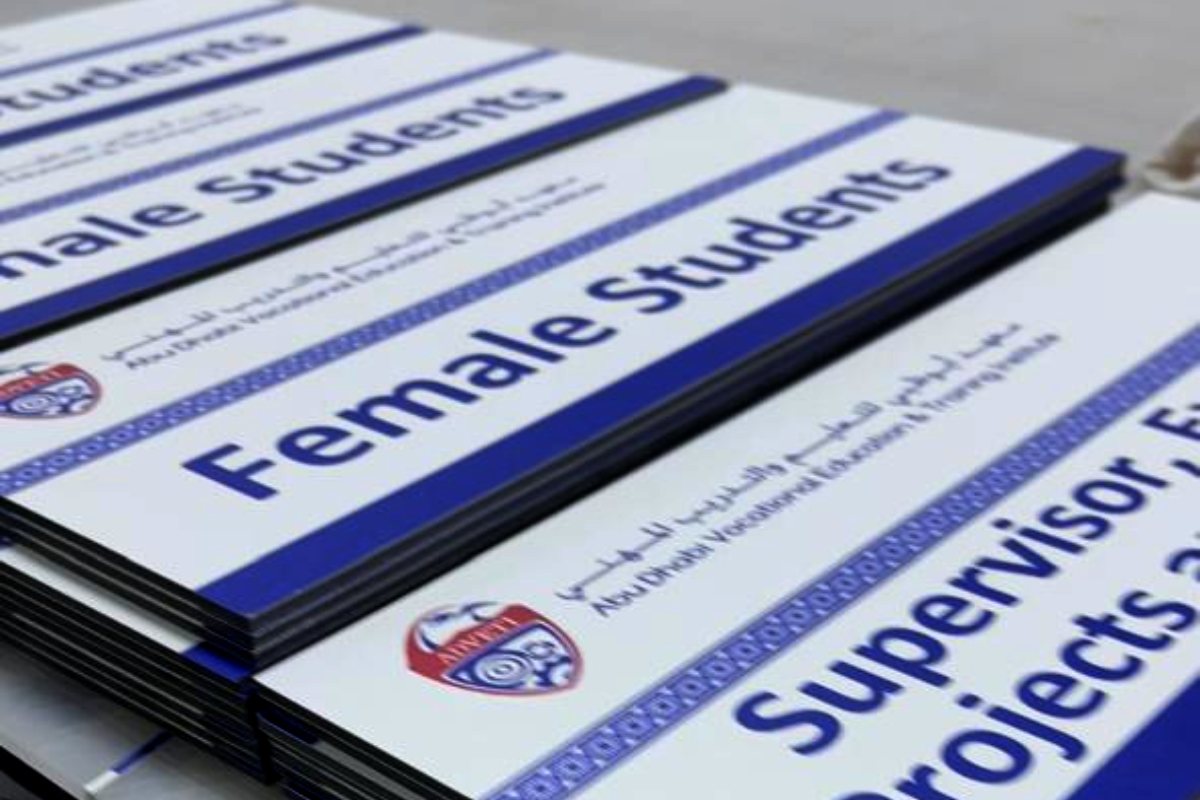
Office door signs are used at the door level. They confirm what is behind the door and help visitors know they have reached the correct destination. They work well for executive offices, meeting rooms, private cabins, staff areas, consultation rooms, and back-of-house rooms.
Room name plates are more content-focused. They label the room itself. Examples include Meeting Room 1, Training Room, Prayer Room, Waiting Room, Store Room, Server Room, Pantry, Male Toilet, Female Toilet, or Accessible Toilet.
Department signs identify business functions. HR, Finance, Accounts, Operations, Administration, Sales, IT, Reception, Claims, Customer Service, and Procurement are common examples.
Room number signs are used when the number matters more than the name. Hotels, clinics, schools, apartments, and multi-suite commercial floors often need room numbering that remains consistent across many doors.
Suite signs are used for commercial offices, serviced offices, clinics, law firms, consultants, and building tenants. They often combine company name, logo, suite number, and sometimes floor information.
The best setup is usually a controlled system: one design language, one material family, one typography rule, one mounting logic, and one naming hierarchy. Without that, every door becomes its own tiny rebellion.
Office Name Plates, Office Name Boards and Wall Name Plates
Many buyers search for office name plates when they actually need different identification signs across the same workplace.
An office name plate may refer to a door-mounted cabin sign, a manager name plate, a doctor room sign, a staff designation plate, a wall-mounted department plate, a suite entrance sign, or a desk name plate. The phrase is broad, so the right specification depends on where the sign is installed and how often the name will change.
Office door name plates are usually fixed to doors or beside doors. They identify private offices, executive cabins, staff rooms, consultation rooms, meeting rooms, and service rooms.
Wall name plates are usually installed beside entrances, on corridor walls, near department zones, or at suite entry points. They work well when the door material is not suitable for direct fixing, when the sign needs to be larger, or when the wall offers better visibility than the door leaf.
Office name boards are usually used in reception areas, company entrances, suite entrances, or department walls. They often carry the company name, department name, logo, or tenant identity rather than only a room name.
Desk name plates are different again. They identify a person, role, counter, reception position, or workstation. They are useful for reception desks, customer service counters, shared offices, clinics, and formal office environments, but they should not be confused with door and room identification signs.
In simple terms, the wall or door location decides the sign type. A door sign identifies the room. A wall name plate identifies a zone, department, or suite. An office name board supports company or reception identity. A desk name plate identifies a person or role at a workstation. Very exciting, naturally, but also the difference between a clean system and a corridor full of random labels.
Common Types Used Inside Abu Dhabi Offices and Buildings
Acrylic Door Signs
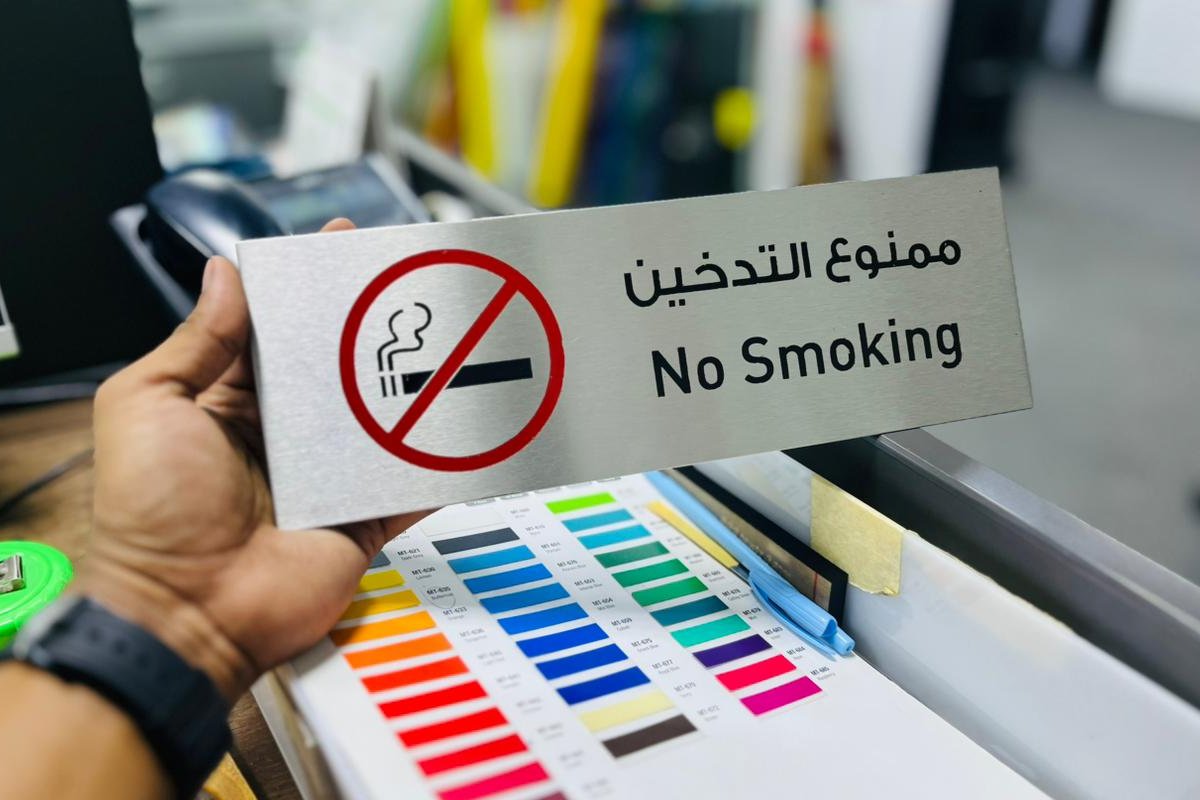
Acrylic door signs are common in Abu Dhabi offices because they look clean, can be printed or engraved, and suit modern interiors. They can carry a logo, room name, department name, staff name, designation, room number, or directional symbol.
Acrylic works well for meeting rooms, office cabins, staff rooms, clinics, schools, and corporate corridors. It can be clear, frosted, white, black, coloured, or layered depending on the brand style.
Acrylic name plates are also useful when an office wants a clean finish without the heavier look of metal. For more permanent branded applications, custom acrylic signage can extend beyond doors into reception signs, wall logos, plaques, and display panels.
Stainless Steel and Metal Name Plates
Stainless steel name plates and metal name plates are used when the sign needs a premium, durable, corporate finish. They suit executive offices, legal firms, financial offices, clinics, hotels, government-style interiors, and high-end commercial buildings.
They can be brushed, mirror-finished, engraved, etched, cut, or combined with acrylic inserts. Stainless steel is stronger than basic printed plastic and gives more weight to formal office interiors.
Metal office name plates are especially useful for executive cabins, boardrooms, reception corridors, VIP areas, and suite entrances where the sign must feel permanent and controlled rather than temporary.
Engraved Room Name Plates
Engraved room name plates suit permanent rooms and operational spaces where the text is unlikely to change. They work well for server rooms, electrical rooms, pantries, toilets, clinics, stair areas, storage rooms, and service zones.
Engraving is useful where cleaning exposure, touch, and long-term use matter. Printed graphics can look excellent, but engraving gives more permanence when the sign is exposed to daily handling.
For fixed rooms such as Pantry, Server Room, Electrical Room, Meeting Room, Reception, Prayer Room, or Room 101, engraved signs usually make more sense than replaceable inserts.
UV-Printed Door Signs
UV-printed door signs allow brand colours, icons, bilingual text, and full-colour graphics to be printed directly onto acrylic, aluminium, or other rigid materials.
This is useful when the signage system needs Arabic and English, department colours, icons, room codes, doctor names, staff titles, or brand-specific layouts. It is also useful for clinics, schools, training centres, and corporate floors where each room has a consistent visual template.
UV printing is often selected when the sign must look branded but still remain part of a wider room identification system.
Changeable Signs and Interchangeable Signs
Changeable insert signs use an acrylic or aluminium holder with a replaceable printed insert. They are useful when names, staff titles, doctors, tenants, classes, or room functions change regularly.
These are practical for serviced offices, clinics, schools, HR departments, co-working spaces, and multi-tenant buildings. The housing stays fixed, while the paper, acetate, printed insert, or name strip changes.
Changeable office name plates are not always the most luxurious option, but they are often the most operationally intelligent. Shocking, I know.
Sliding Occupied / Available Signs
Slider signs are used for meeting rooms, therapy rooms, consultation rooms, phone booths, prayer rooms, washrooms, and private rooms where users need to show whether the space is available or occupied.
They prevent awkward interruptions and support simple room control without digital systems. For small rooms and shared office spaces, they are often more useful than another decorative wall quote pretending to inspire productivity.
Vinyl Door Lettering
Cut vinyl lettering is useful when text, numbers, or logos need to be applied directly to glass doors, partitions, or smooth interior surfaces.
It works well for meeting room names, office names, opening hours, privacy messages, department labels, and glass-door identification. For glass-heavy offices, cut vinyl lettering can be paired with frosted film or printed glass graphics to create clean identification without drilling into the door.
Standoff Door and Wall Panels
Standoff-mounted signs use small metal spacers to lift an acrylic or metal panel away from the wall. They suit premium offices, reception corridors, directories, department panels, office name boards, and formal identification points.
For larger room signs, floor signs, or wall-mounted panels, acrylic standoff signs can create a floating display effect that looks more permanent than a flat sticker or printed plate.
Where Door Signs and Room Name Plates Are Used
Office door signs and room name plates are used across many building types in Abu Dhabi.
Corporate offices use them for executive cabins, meeting rooms, departments, boardrooms, focus rooms, pantries, server rooms, office name plates, and manager cabin name plates.
Clinics and healthcare centres use them for consultation rooms, treatment rooms, waiting rooms, nurse stations, doctor rooms, lab rooms, patient navigation, and bilingual clinic room name plates.
Hotels and serviced apartments use hotel room number signs, hotel door number plates, service room signs, staff-only signs, lift lobby signs, floor signs, and back-of-house identification.
Schools and training centres use classroom signs, admin office signs, staff room signs, lab signs, library signs, and directional room labels.
Residential buildings use apartment number plates, unit number signs, floor identification, amenity room signs, mailroom signs, gym signs, pool signs, and service-area labels.
Commercial towers and business centres use tenant suite signs, department signs, office name boards, floor directories, lift lobby identification, and corridor door labels.
For multi-tenant buildings, door signs should connect with lobby directory signs, so visitors can read the tenant name downstairs, follow the floor guidance, and confirm the exact suite or department at the door.

Door Signs as Part of a Complete Wayfinding System
A door sign is not isolated. It is the final confirmation point in the visitor journey.
The journey usually starts with a lobby directory or reception sign. It continues through directional signs, corridor signs, lift lobby signs, floor signs, and department markers. It ends at the office door, meeting room, clinic room, suite, or apartment.
That is why door signs should match the wider wayfinding signage system. If the lobby directory uses one naming style, the corridor signs use another, and the door signs use a third, the building feels improvised.
A clean system controls:
- English and Arabic naming
- Font size and viewing distance
- Room number hierarchy
- Icon style
- Department naming
- Colour coding
- Material finish
- Mounting height
- Door or wall position
- Update method
This is especially important in clinics, commercial towers, schools, serviced offices, and shared corporate floors where visitors may not know the building layout.
For overhead, corridor, and junction guidance, wayfinding signs can work alongside door identification, lobby directories, glass markers, and room signs.
Choosing the Right Material and Format
The right office door sign depends on the room, surface, update frequency, and interior finish.
For a permanent executive room, engraved acrylic, stainless steel, or metal name plates may be suitable.
For manager cabins and private offices, office door name plates should look formal without becoming oversized or decorative.
For meeting rooms and shared rooms, acrylic, frosted glass graphics, slider signs, or changeable plates may work better.
For clinics and schools, readable room names, numbers, and bilingual layouts are more important than decorative effects.
For doctors, consultants, teachers, and tenant offices, changeable office name plates may reduce replacement costs when people move or titles change.
For apartments and hotel rooms, numbering consistency and batch production matter more than one-off customization.
For glass doors, vinyl lettering or standoff-mounted panels are usually better than drilling through the glass.
For gypsum walls or painted corridors, lightweight acrylic or aluminium panels can work well, but fixing method must match the substrate.
For high-end reception corridors, door plates may need to match 3D reception signs, wall branding, and acrylic display panels so the whole office feels designed, not assembled from a drawer of leftovers.
Fixed Signs vs Changeable Insert Systems
This is one of the most important decisions.
Fixed signs are best when the room name rarely changes. Examples include Pantry, Server Room, Meeting Room, Reception, Prayer Room, Store Room, and Room 101.
Changeable signs are better when names or functions change often. Examples include staff name plates, doctor room signs, department allocations, serviced office suites, training rooms, and tenant listings.
A fixed sign usually looks more polished. A changeable sign usually reduces future replacement costs.
For Abu Dhabi property managers and office administrators, this decision matters because replacing a full set of signs every time a tenant changes is a delightful way to burn budget for no reason.
Arabic and English Layouts
Many Abu Dhabi buildings need bilingual signage. Arabic and English should not be squeezed into a layout as an afterthought.
A proper bilingual door sign controls reading order, spacing, font weight, alignment, and contrast. If Arabic text is too small, English dominates the sign. If both languages are crowded, neither reads well.
Bilingual room signs are especially useful in clinics, schools, government-related offices, commercial towers, mixed-use buildings, and public-facing facilities.
Arabic and English office signs should be planned before fabrication, especially when room names, department names, staff titles, or doctor names are long. A clean bilingual layout is not just translation. It is spacing, hierarchy, legibility, and restraint, which humans occasionally remember to use.
For a professional result, the design should decide:
- Which language appears first
- Whether both languages use equal scale
- How room numbers align
- Whether icons are needed
- How long department names will fit
- Whether future name changes are expected
The cleaner the naming system, the easier the signage becomes. This is why the wording should be finalized before fabrication, not discovered halfway through installation like a plot twist nobody requested.
When to Use Desk Name Plates Instead
Desk name plates are useful when the identification belongs to a person, role, reception counter, or workstation instead of a room.
They are often used for reception desks, front counters, customer service desks, shared office desks, clinic reception areas, bank-style counters, and formal executive offices. A desk name plate may show a staff name, job title, department, language ability, or counter function.
Desk name plates are not a replacement for office door signs. They work after the visitor has entered the room or reached the counter. Door signs and room name plates help people find the correct location before they enter.
For complete office identification, some Abu Dhabi workplaces use both systems: door signs for rooms and departments, wall name plates for zones, and desk name plates for people or service counters.
Clinic, Hotel and Building-Specific Name Plates
Different building types need different room identification logic.
Clinics usually need doctor room signs, consultation room signs, treatment room signs, nurse station signs, lab room signs, waiting room signs, and bilingual clinic room name plates. If doctors or room functions change often, modular insert systems can reduce replacement work.
Hotels and serviced apartments usually need hotel room number signs, hotel door number plates, service room signs, staff-only signs, lift lobby identifiers, amenity signs, and back-of-house labels. Consistency matters because one mismatched room number can break the visual order across a whole floor.
Commercial towers and business centres usually need tenant suite signs, office name plates, floor directory links, lift lobby signs, department plates, and corridor door labels. These signs should match the lobby directory and the building’s wayfinding logic.
Residential towers usually need apartment number plates, unit number signs, floor identification, mailroom signs, gym signs, pool signs, and service-area labels. The design can be simpler than a corporate office system, but numbering consistency still matters.
Related Abu Dhabi Project Examples
For a real office branding rollout with identification signs, wall branding, directory-related product links, and interior signage context, view the Kent Abu Dhabi office branding project.
For a project showing office signage, glass frosting, lobby directory plates, elevator-adjacent signage, and office numbering, view the Global Beam Telecom office signage project.
For a project connected to identification signs and office privacy graphics, view the Mesar Abu Dhabi office branding project.
For a high-security office interior where glass branding and identification signs support a controlled executive environment, view the EIA office frosted glass project.
You can also browse the full Abu Dhabi signage project portfolio to see completed interior signage, office branding, and wayfinding-related work.
Related Interior Signage Services
Office door signs often work best when planned with other indoor signs instead of ordered alone.
For reception walls and brand arrival points, explore 3D reception signs.
For rigid logo panels, plaques, and branded interior signs, explore acrylic signage.
For floating wall panels and directory-style displays, explore acrylic standoff signs.
For tenant listings and building navigation, explore lobby directory systems.
For complete visitor movement across offices, clinics, towers, and campuses, explore wayfinding signage systems.
For broader indoor brand environments, explore interior signage in Abu Dhabi.
For more planning guidance, read Indoor Office Signs in Abu Dhabi, Professional Interior Signage Systems for Abu Dhabi Offices, and Corporate Office Branding Ideas in Abu Dhabi.
Need Office Door Signs or Room Name Plates in Abu Dhabi?
Share your floor plan, room list, door count, preferred material, and whether names will change in the future. Ninety Nine Advertising LLC can design, fabricate, and install office door signs, room name plates, office name plates, department signs, suite signs, desk name plates, wall name plates, and room numbering systems for Abu Dhabi offices, clinics, towers, hotels, schools, and managed interiors.

Related Content


B2B Procurement Guide: Hiring an Outdoor Signage Manufacturer in Abu Dhabi
Read Full Article →

Vehicle Branding Ideas in Abu Dhabi: Car Stickers, Van Wraps & Bus Branding
Read Full Article →
Vehicle Branding in Abu Dhabi: Vehicle Wraps, Car Decals and Costs Explained
Read Full Article →
Shop Front Glass Stickers Abu Dhabi: The Ultimate Window Branding Guide
Read Full Article →