Outdoor Signage

Updated On
April 2, 2026
Written by:
Ninety Nine Advertising Technical Team

What Outdoor Signage Covers
Outdoor signage covers every externally placed commercial sign type — shopfront signboards, blade signs, pylon signs, monument signs, building facade letters, rooftop signs, and illuminated lightboxes — installed on commercial properties to establish identification, brand presence, and approach visibility from the road.
The category applies across street-level retail strips, multi-storey commercial and office buildings, compound-format industrial sites in Musaffah, showroom corridors on high-traffic approach roads, and mixed-use developments on Yas Island and Saadiyat Island. Each sign type addresses a specific visibility distance and property geometry — from kerb-level fascia identification to driver-distance building facade lettering on towers.

Who Exterior Signage Is For
A shopfront tenant on a retail strip requires a fascia or blade sign that converts approach visibility into footfall at the unit level — the sign is the identification layer between the passing pedestrian and the entrance. A building owner or property manager is concerned with how the building reads from the road — facade and rooftop signs are the asset that establishes address recognition at driver distance. A retail chain operator needs a consistent sign specification held across every location in the network, so that brand legibility is uniform whether a unit is on an Airport Road corridor or a neighbourhood retail cluster. A compound operator or industrial showroom requires an approach marker — typically a pylon structure — that registers in a driver's sightline well before the turn decision point.
Sign type, scale, and specification are determined by which of these operational requirements the installation is being asked to fulfil.
Explore Our External Signage Solutions
Our outdoor signs are specified for visibility, site presence, and long-term performance across Abu Dhabi commercial properties. Pricing, turnaround, and warranty details are on each product page.

Outdoor Storefront Signboards

High-Rise Building Facade Signage

Outdoor Flex Lightbox Signs

Exterior Blade Signs

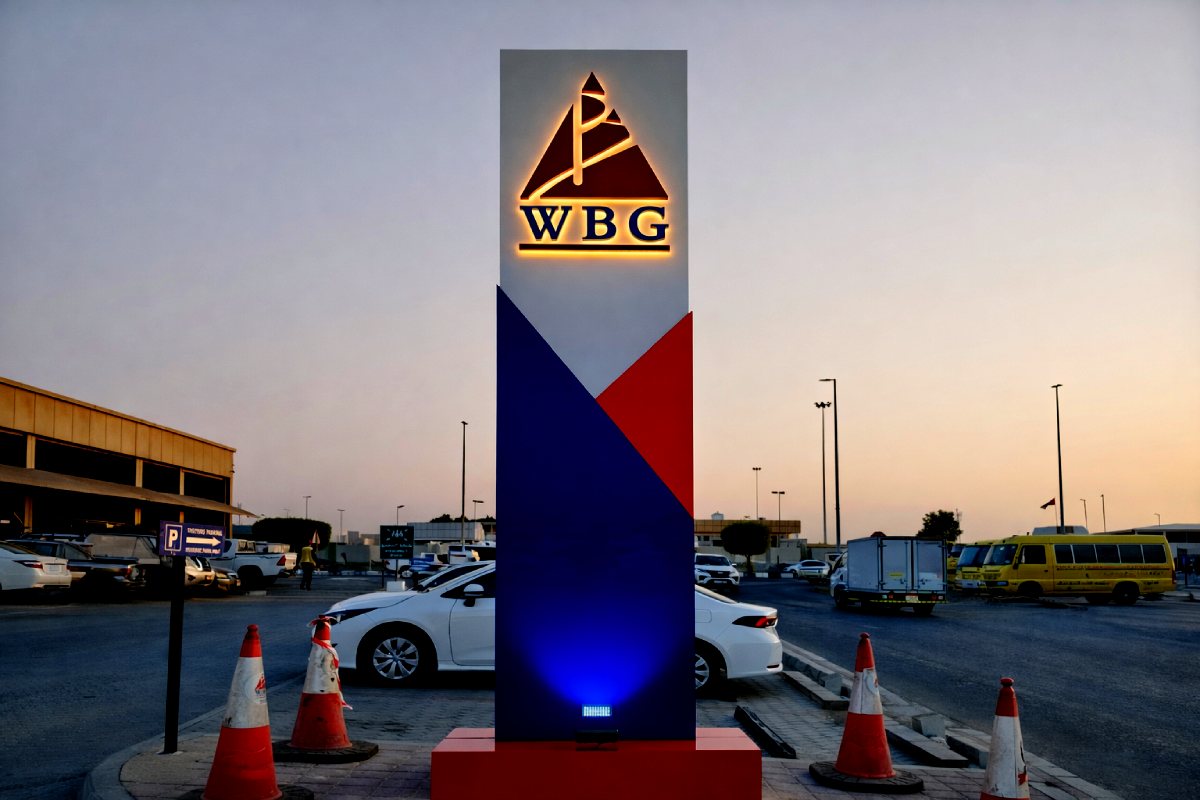
Outdoor Pylon Signs and Monoliths

Rooftop & Skyline Signage
Projects Delivered: Outdoor Signage Installations Across Abu Dhabi
Explore recent projects delivered across Abu Dhabi for retail, commercial, corporate, hospitality, healthcare, and public-facing environments. This section highlights real applications of our work across different project types, showing how design, production, and installation come together in live business settings. Each example reflects practical execution, local relevance, and category-specific delivery experience.
.webp)


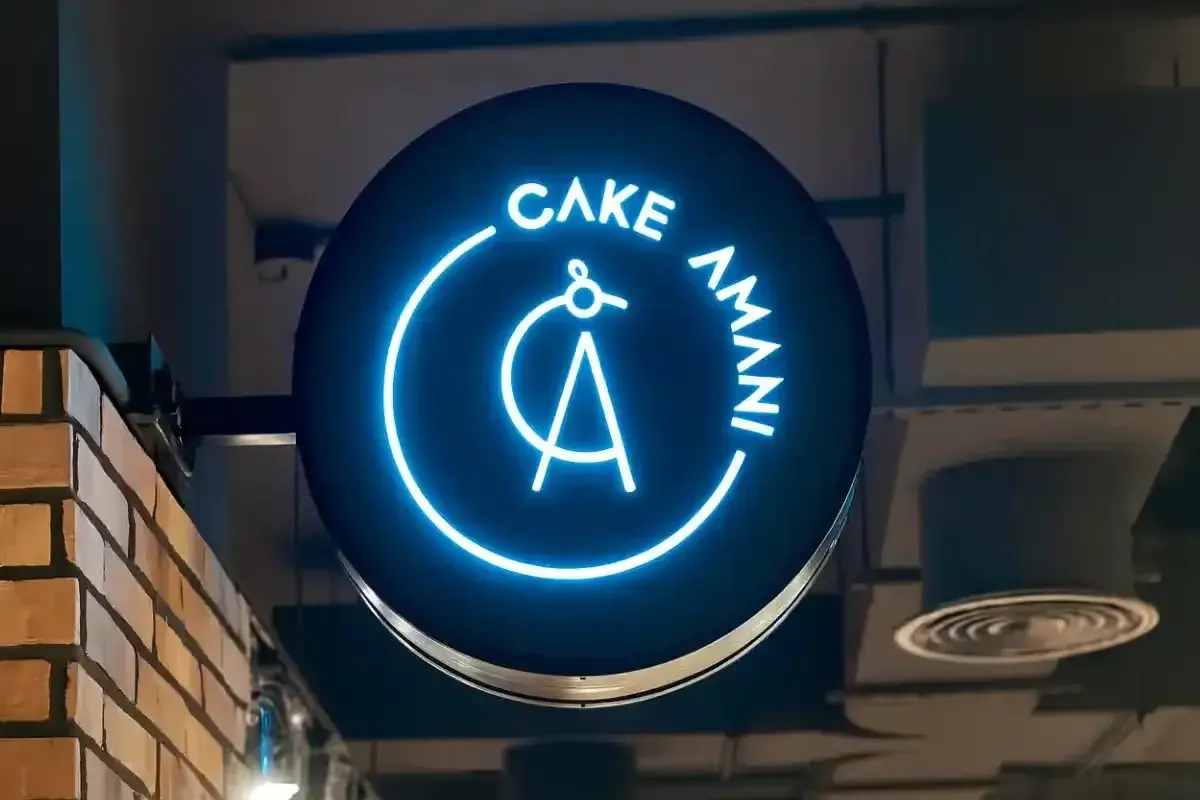
Cake Amani — Airport Road, Abu Dhabi
Scope: 17m × 2.5m integrated retail facade with RAL-matched 3D aluminium strip cladding and Samsung Chip LED illumination.The Airport Road installation marked Cake Amani's expansion into a new geographical location — the facade sign established brand presence at the scale the corridor's approach distance required for a newly opened site with no prior footfall recognition at that address.
Life Pharmacy — Abu Dhabi, Al Ain, and Dubai
Scope: 18-month phased rollout of 20-plus signboards and rooftop displays across retail locations including Al Mariah Mall and Al Maqtaa Mall. Specified with 10,000K Samsung Chip LEDs, Mean Well HLG Series drivers, 3D acrylic front-lit letters, and custom-coated 4mm ACP — consistent specification held across street-side, rooftop, and mall facade formats throughout the network.
ADASI — Restricted-Access Technology Facility, Abu Dhabi
Scope: 29-set facade rollout comprising 20 3D aluminium logo sets and 9 facility identification signs. Engineer-grade powder-coated aluminium with RAL matching. Fabricated and installed within a 20-day deadline with a dedicated Safety Inspector and certified scaffolding erectors operating under HSE compliance requirements on a private restricted-access Abu Dhabi site.


Exterior Sign Types and What Each One Does in Abu Dhabi
Building Facade Signs and Rooftop Letters for Abu Dhabi Commercial Buildings
We fabricate facade 3D letters and rooftop structural signs in powder-coated aluminium, UV-stable cast acrylic, and IP67-rated LED systems. At driver distance, a building without high-level identification remains unnamed from the road — legible only once a visitor is already at the entrance, not at the approach. IP67-rated LED systems are specified throughout: fully sealed against dust ingress and water penetration, both sustained conditions across Abu Dhabi's outdoor exposure cycle. For a building owner, this is the asset that determines how the address reads before any visitor decision is made.
Pylon Signs and Monument Entrance Structures for Abu Dhabi Sites
We engineer pylons in structural steel with powder-coated aluminium cladding, sized to Abu Dhabi wind load requirements. A pylon at four metres and above enters a driver's sightline at 80 metres from the turn, clearing surrounding walls, landscaping, and parked vehicles; a monument sign at 0.8 to 1.5 metres identifies an entrance for visitors already on site — the two structures address different arrival distances and are not interchangeable. For a compound or industrial operator, the pylon is the approach marker that generates the deceleration decision before the turn opportunity passes.
Shopfront Signboards and Blade Signs for Abu Dhabi Retail Units
We supply shopfront signboards and blade signs fabricated in UV-stable cast acrylic and powder-coated aluminium frames. Cast acrylic holds colour under sustained UV exposure; extruded acrylic yellows progressively, reducing legibility within the sign's service life — the material choice determines whether brand appearance holds across the full installation period. A blade sign extends approach visibility perpendicular to the fascia, which matters in retail clusters where footfall arrives from multiple directions. For a retail chain operator, consistent material specification across every unit holds visual coherence across the network.
Illuminated Lightboxes and Outdoor Display Signs for Abu Dhabi Shopfronts
We fabricate illuminated lightboxes with aluminium cabinet bodies, opal acrylic faces for small to medium retail installations, and backlit flex faces for large shopfront runs where a replaceable face skin reduces long-term maintenance cost. Opal acrylic diffuses the LED source evenly across the face without hotspots; backlit flex allows the face skin to be replaced without rebuilding the cabinet — the material choice determines diffusion quality, maintenance access, and colour stability across Abu Dhabi's UV and heat exposure cycle. For a shopfront tenant or property team managing a multi-tenant facade, the lightbox maintains consistent brand presence through the high-footfall evening trading period.
Why External Signs Fail and How We Prevent It
Commercial exterior signs in Abu Dhabi serve shopfront tenants, building owners, property managers, and retail chains — each with distinct visibility requirements, approval conditions, and site constraints that define the specification from the outset.
Four failure modes account for most premature sign failures in this market. Face delamination occurs when adhesive systems are not rated for Abu Dhabi's 48°C peak temperatures — the bond degrades progressively as the substrate expands and contracts through daily heat cycles.
LED driver failure results from underspecified electrical components that cannot sustain consistent output under sustained ambient heat, reducing illumination before the sign reaches mid-service life. Frame corrosion on coastal-zone installations develops when aluminium is not correctly prepared before powder-coat is applied, allowing salt-driven oxidation to advance beneath the finish. Water ingress behind mounted letters follows from inadequate edge sealing at installation, allowing moisture to track into the fixing cavity. Ninety Nine Advertising addresses all four at specification and installation stage — before the sign leaves the workshop.
Cake Amani on Airport Road received a 17m × 2.5m integrated retail facade incorporating RAL-matched 3D aluminium strip cladding and Samsung Chip LED illumination, specified for the frontage scale and UV exposure of that corridor. Life Pharmacy's Abu Dhabi network spans 20-plus locations delivered across 18 months, with large-format signboards and rooftop displays built to a consistent specification using 10,000K Samsung LEDs and custom-coated ACP. ADASI — Autonomous Systems Innovation and Development — received a 29-set facade rollout at their Abu Dhabi facility comprising 20 3D aluminium logo sets and 9 facility identification signs, fabricated and installed within a 20-day project deadline against the structural and security access requirements of a high-profile technology site.


Materials for Outdoor Signage for Coastal Conditions
Abu Dhabi outdoor signs face four simultaneous exposure conditions: 48°C peak temperatures, UV Extreme classification for the majority of the year, blowing dust abrasion, and coastal salt deposition across waterfront districts — material selection starts with performance, not appearance at installation.
Frames and housings are specified in custom powder-coated aluminium or fire-rated 4mm ACP. Coastal-zone aluminium receives a corrosion-resistant primer before powder-coat — omitting this step allows salt-driven oxidation to advance beneath the finish, producing visible corrosion within two to three years.
Illuminated faces are specified in PLEXIGLAS LED-grade PMMA, opal white grade — diffusing the LED source evenly across the full face, eliminating hotspots, and carrying a manufacturer guarantee of no visible yellowing for 30 years under direct exterior UV.
LED illumination is specified with Samsung chip LEDs and Mean Well HLG Series constant-voltage drivers, IP67-rated throughout against dust ingress and water penetration. Standard commercial-grade drivers under Abu Dhabi's sustained ambient temperatures lose consistent lumen output within two years; correctly specified drivers hold output across the full service life.
For panel bonding we specify 3M VHB Tape 5952F — rated for 93°C long-term and 149°C short-term service — preventing face delamination at the panel-to-frame interface. Higher heat-load assemblies use 3M VHB GPH-110GF, rated for 149°C long-term service. Illuminated face graphics are specified with 3M Envision Translucent Film 3730, clear pressure-sensitive acrylic adhesive rated from -45°C to +77°C. Perimeter weather sealing uses DOWSIL 791 neutral-cure sealant at joint lines and cabinet closures — silicone is not used for panel bonding or film adhesive.
Correct material specification confirmed at project start eliminates the four outcomes that define premature sign failure: colour degradation, face delamination, frame corrosion, and LED driver failure.


.webp)


Permits, Approvals and Compliance in Abu Dhabi
Handling compliance late in a signage project creates predictable costs: permit rejection and redesign, fabrication committed before structural documentation is confirmed, and programme delays that push installation beyond the contracted window. These are avoidable when approvals start at project planning not after.
Commercial signage compliance in Abu Dhabi operates through two instruments. DMT Regulations Version 5 sets the rules for permitted categories including ground-floor, supplementary, colonnade, industrial, and freestanding signs, with dimensional limits, mounting positions, illumination permissions, and concealment requirements. TAMM is the portal through which permits are issued, renewed, amended, and cancelled against a business licence, address, and sign configuration.
Permit timelines vary by sign type and review requirement. A standard shopfront sign runs five to seven days through TAMM. Pylon signs, rooftop signs, and high-level facade 3D signage requiring structural review take three to four weeks.
Method statement approved from the building owner before drilled fixing is required. Committing fabrication before confirmation transfers costs to the client budget.
This approach confirms the sign type, position, fixing method, approved facade zone, maximum dimensions, and reinstatement obligations against lease conditions. Ninety Nine Advertising manages NOC coordination and TAMM submission as one project scope.
We arrange a site assessment before any specification is committed. This confirms the permitted sign type, approved frontage zone, and structural requirements for your property, so fabrication begins with the permit file in order.
From Site Assessment to Installed Sign
Outdoor signage delivery is the staged process of turning a site requirement into a compliant, fabricated, and properly installed exterior sign. In Abu Dhabi, that process needs to balance visibility, site conditions, structural practicality, and approval readiness from the start so the sign works both on the property and within the required submission route.
Site and Signage Assessment
The planning stage reviews the property frontage, viewing angles, access constraints, sign positions, and site-specific conditions — including coastal exposure zones where frame specification requires Jotun primer — before any specification is committed. We conduct a site assessment before any scope is agreed, confirming the sign type, structural fixing requirements, and approach sightline so that specification changes after contracting begins are eliminated at the outset.
Engineering and Contracting
Detailed scope, material specification, artwork, and all required approvals are confirmed and agreed before production begins. We lock material grade against Abu Dhabi's exposure conditions, proof artwork against DMT Version 5 dimensional and content requirements, coordinate landlord NOC where the unit is leased, and submit through the TAMM portal — no fabrication begins until the permit file and contractual scope are both closed.
Fabrication
Signs are fabricated against the confirmed specification and approved artwork, with quality checks completed before any unit leaves the workshop. We build to confirmed materials — powder-coated aluminium or fire-rated 5mm ACP frames, PLEXIGLAS LED-grade PMMA faces, Samsung chip LEDs, Mean Well HLG Series drivers, 3M VHB panel bonding, and 3M Envision Translucent Film 3730 on illuminated faces — with installation access and scheduling coordinated with the buyer before dispatch.
Installation and Handover
Installation is completed with structural fixing, edge sealing, and electrical connection confirmed against the approved specification before handover is accepted.
We verify fixing torque, DOWSIL 791 perimeter sealing at all joint lines, IP67 electrical connection integrity, and final face alignment against approved artwork — handover is completed only when the installed sign matches the confirmed specification in full.
Common Questions About Outdoor Signage in Abu Dhabi
Common queries about services, permit timelines, and installation in Abu Dhabi.
What is included in outdoor signage services?
Outdoor signage services cover site assessment, sign type recommendation, design and technical proposal, permit preparation and TAMM portal submission under DMT Regulations Version 5, fabrication, and installation. For leased units, landlord NOC coordination is included before permit submission opens. Compliance is part of every exterior sign project — sign placement, dimensions, illumination format, and content are all governed under DMT Version 5 and managed as standard scope.
Which sign type is right for my property?
Sign type is determined by viewing distance, building geometry, and the sign's operational role. Street-level retail requires a fascia signboard or blade sign. Compounds and industrial sites with vehicular approach roads require a pylon structure. Multi-storey buildings and towers require facade 3D letters or rooftop signs for driver-distance visibility. A site assessment confirms the sightline requirement and the correct sign type before specification is committed.
What materials work better in Abu Dhabi weather?
Abu Dhabi outdoor signs face 48°C peak temperatures, UV Extreme classification, dust abrasion, and coastal salt deposition. Frames are custom powder-coated aluminium or fire-rated 5mm ACP. Coastal-zone aluminium receives Jotun corrosion-resistant primer before powder-coat. Non-illuminated faces use UV-stable cast acrylic. Illuminated faces use PLEXIGLAS LED-grade PMMA, opal white grade. LED modules and drivers — Samsung chip LEDs and Mean Well HLG Series — are IP67-rated throughout.
How do you stop signs from fading in the heat?
Fading is primarily a UV and heat issue resolved at material specification stage. Non-illuminated exterior sign faces are typically specified in UV-stable cast acrylic for long-life performance; low-grade acrylic is avoided, but extruded PMMA is not excluded by default. Illuminated faces are specified in LED-grade PLEXIGLAS PMMA, opal white grade, for backlit sign applications. Printed translucent faces use 3M Envision IJ3730-50 or IJ3730-60, rated for approximately -44°C to +77°C after application.
What causes signs to fail prematurely — and how is that avoided?
Four causes account for most premature sign failures in Abu Dhabi: face delamination from panel bonding not rated for local thermal load; LED driver failure from underspecified components; frame corrosion on coastal-zone aluminium not correctly primed before powder-coat; and water ingress from inadequate edge sealing at installation. Full cause and consequence detail for each failure mode is covered in the specification section above. All four are addressed at specification and installation stage before the sign leaves the workshop.
How much does outdoor signage cost?
Fabrication runs from AED 550 to AED 1,850 per square metre, determined by material specification, structure type, and electrical component grade. Non-illuminated lettering and standard lightboxes sit at the lower end. Built-up illuminated 3D letters with PLEXIGLAS LED-grade faces, Samsung chip LEDs, and IP67-rated Mean Well HLG Series drivers sit at the upper end. Site costs — access, structural fixing, and electrical connection — are additional and vary by sign type and location. Itemised proposals are produced on confirmed project parameters.
What is the difference between a pylon sign and a monument sign?
A pylon is a tall freestanding structure — typically four metres and above — engineered to enter a driver's sightline at distance from the turn. A monument sign is lower — typically 0.8 to 1.5 metres — built for entrance identification where the visitor is already on site. The two structures address different arrival distances and are not interchangeable. Full height ranges, sightline distances, and structural specification detail are covered in the sign types section above.
Do outdoor signs in Abu Dhabi need permit approval?
Yes. All commercial exterior signs are governed under DMT Regulations Version 5, covering permitted sign categories, dimensional limits, illumination format, architectural feature coverage, and cable and lighting concealment. Applications are submitted through the TAMM portal, tied to a specific business licence, address, and sign configuration. A standard shopfront sign runs five to seven working days for approval. Pylon, rooftop, and high-level facade signs requiring structural review take three to four weeks.
Do I need a structural engineer's report for my outdoor sign?
Not for every sign type. Rooftop signs, large high-level facade letters, and tall pylon structures typically require a structural stability certificate at municipal level and a structural method statement for the building owner before drilled fixings are approved. Many Abu Dhabi managed properties require the method statement regardless of sign scale. Where structural documentation is required, this is coordinated as part of project scope before fabrication begins.
Can I install a sign on a leased commercial unit?
Yes. Leased units are among the most common sign projects handled in Abu Dhabi. The practical difference from a freehold installation is a landlord NOC layer that precedes TAMM submission — confirming sign type, position, fixing method, approved facade zone, maximum permitted dimensions, and reinstatement obligations under the lease. Once landlord consent is confirmed, TAMM permit submission proceeds identically to any commercial sign project.
How long does a sign project take from assessment to installation?
Project duration varies by sign size, fabrication complexity, approval requirements, and site access. Smaller shopfront signage projects typically complete within 5 to 10 days. Larger or more complex projects — those involving structural review, permit approval, or restricted site access — typically run 14 to 21 days depending on scope and conditions. Installation is scheduled around building access windows, safety controls, and any required inspections.
Can I update the artwork on an existing sign without replacing the full sign?
Artwork updates on existing signs are technically possible in limited cases, but the scope is constrained by how signs are constructed. Electrical systems require full replacement rather than partial modification. 3D letters and illumination components must also be replaced in full — partial replacement creates visible colour and illumination output inconsistency across the sign face. In most cases, the cost of a correct full replacement is the more reliable route than a partial refurbishment that leaves mismatched components in place.